
Australia Immigration New Rules
admin
April 15, 2026
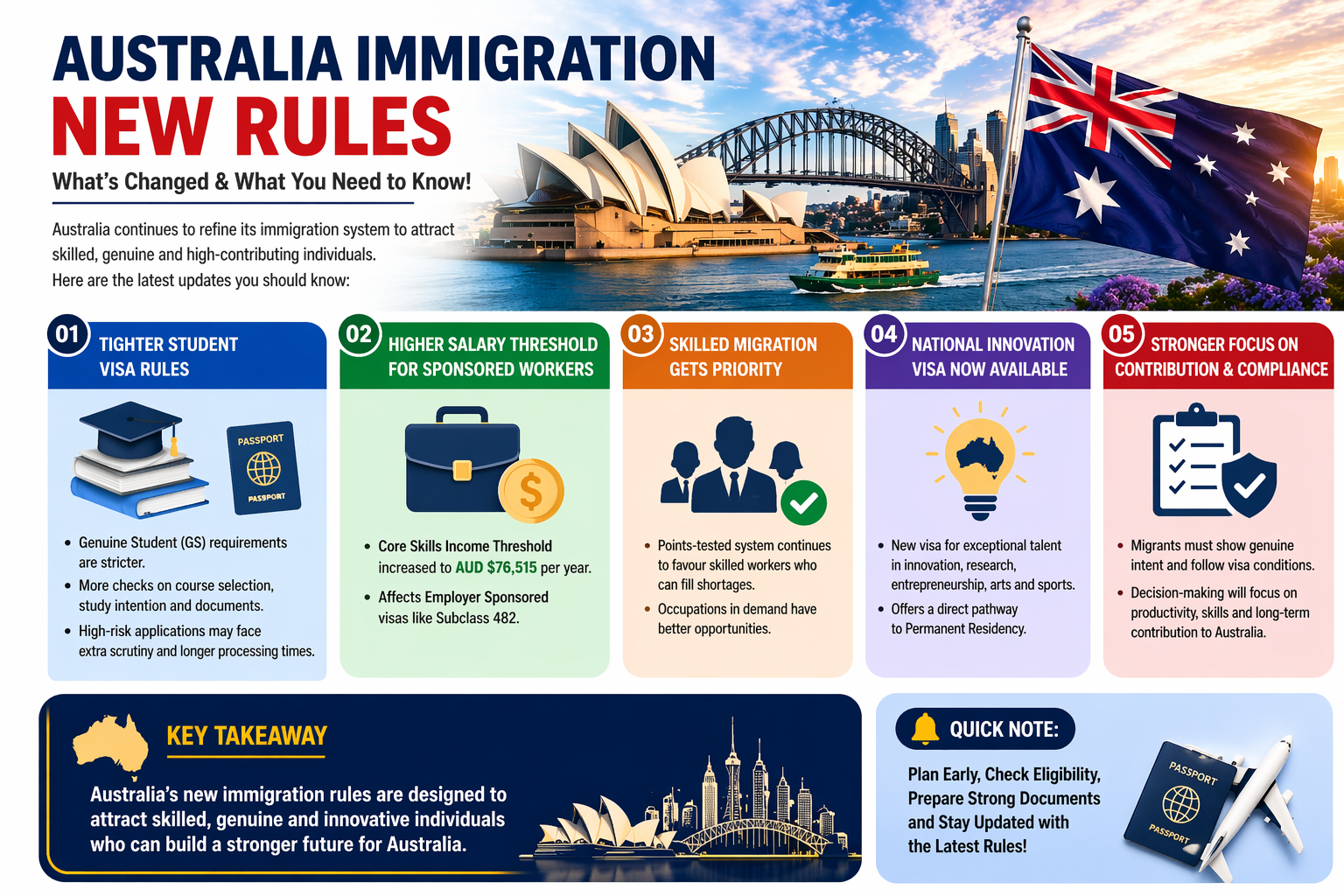
Australia Immigration New Rules are changing how students, skilled workers, graduates, and families plan their move to Australia. In 2026, the Australian immigration system has become more selective, with stricter rules around student visas, English language requirements, financial proof, salary thresholds, and graduate visa eligibility. Anyone planning to migrate should understand these updates clearly before starting the application process Australia immigration new rules have changed the way many people plan their move to Australia. Whether someone is applying as an international student, a skilled worker, a graduate, or a family applicant, the system is now more selective, more document-focused, and more serious about genuine intent. Australia is still open to migrants, but the government has tightened several settings to reduce misuse and align migration with skills needs and education integrity.
For applicants, this means one thing: old information is risky. A person who relies on outdated advice may prepare the wrong documents, budget the wrong amount, or choose the wrong pathway. The newer rules affect student visas, graduate visas, salary thresholds for skilled visas, and how onshore student applications are handled.
This detailed blog explains the Australia immigration new rules in simple language so students, professionals, parents, and migration planners can understand what has changed and how to prepare properly.
Why Australia Changed Its Immigration Rules
Australia’s immigration changes are part of a broader effort to improve the migration system. The government has been focusing on stronger integrity in the education sector, better targeting of skilled migration, and more realistic pathways for people who can contribute to the economy and society. The migration program itself remains active, with the 2025–26 permanent Migration Program still set at 185,000 places, which shows Australia is not closing migration but reshaping it.
The key message behind the reforms is clear. Australia wants genuine students, properly paid skilled workers, and applicants who meet current standards. That means visa applicants must now be more organized, financially prepared, and honest in how they present their case.
Australia Immigration New Rules for Student Visas
Student visa policy is one of the biggest areas where rules have changed.
1. Genuine Student Requirement Replaced the Old GTE Test
One of the most important reforms is the Genuine Student (GS) requirement. This replaced the old Genuine Temporary Entrant (GTE) requirement for Student visa applications lodged on or after 23 March 2024. Under the GS requirement, the applicant must show that studying in Australia is the main reason for applying for the visa.
This matters because weak statements, copied SOPs, and vague study plans now create more risk. Applicants need to explain clearly why they chose the course, how it fits their background, and what value the education has for their future. In simple words, Australia now wants stronger proof that the applicant is a real student and not using the student route for some unrelated migration purpose.
2. Higher English Language Requirements
Australia also raised English language requirements for student and graduate visa pathways. The official update states that the minimum IELTS score required for a Student visa increased from 5.5 to 6.0, while the minimum score for students doing ELICOS before their main course increased from 4.5 to 5.0.
This is a practical change, not just a technical one. Many applicants used to treat English testing as a step they could manage later. Now it plays a much bigger role from the start. Students who are serious about Australia need to prepare for IELTS, PTE, or equivalent tests earlier and more carefully.
3. Higher Financial Capacity Requirement
From 10 May 2024, the amount of money Student and Student Guardian visa applicants need to show was increased. The government said this was updated to better align with a proportion of the national minimum wage.
For families and students, this means financial planning is now more important than before. Applicants need stronger proof of funds, and those funds must make sense in relation to tuition, living costs, and overall study plans. A weak financial file can quickly affect the credibility of the application.
4. Onshore Student Applicants Need a CoE, Not Just an Offer Letter
A major operational change came into effect from 1 January 2025. The Department of Home Affairs said it would no longer accept Letters of Offer from individuals applying in Australia for a Student visa. Onshore applicants must now have a Confirmation of Enrolment (CoE) when they lodge.
This is important for people already in Australia and planning to switch or continue on a student pathway. It reduces the scope for incomplete or rushed applications. Applicants now need to finish admission steps properly before lodging.
5. More Emphasis on Complete Applications
Australia has also been publicly advising applicants to lodge complete student visa applications as early as practical. The Department’s 2026 guidance specifically tells students to lodge complete applications early to help prevent delays, and another official page warns applicants to “check twice” because incomplete files can delay processing or lead to refusal.
This tells us something important about the current system: document quality matters more than ever. A student visa is no longer a file that should be thrown together quickly. It needs planning, proper evidence, and a clear structure.
Australia Immigration New Rules for Temporary Graduate Visa Holders
The Temporary Graduate visa (Subclass 485) has also changed in major ways.
1. Lower Age Limit for Many Applicants
The official Temporary Graduate visa information states that applicants generally must be 35 years or under when they apply, with some exceptions. The Department’s specific changes page also says the maximum eligible age for the Post-Higher Education Work stream was reduced to 35 years or under.
This is a major shift for older international students. In the past, some people used Australian study and a later graduate visa as a stepping stone even at a later stage in life. The newer rule narrows that pathway and makes early planning more important.
2. Higher English Requirement for Graduate Visa Applicants
The same March 2024 update that raised Student visa English requirements also raised the English standard for the Temporary Graduate visa. The minimum IELTS score increased from 6.0 to 6.5, with a minimum score of 5.5 in each test component.
This affects graduates who are counting on post-study work rights. It means they cannot assume graduation alone is enough. English preparation has become an essential part of staying eligible for this pathway.
3. Stream Changes and Tighter Post-Study Settings
The official changes page for the Temporary Graduate visa confirms that program settings were revised, including stream changes and tighter eligibility settings. The broader direction is clear: Australia still allows post-study work, but it now wants that system to be more targeted and less open to misuse.
For students, this means post-study planning must start before graduation, not after. Course choice, age, English score, and long-term migration strategy all need to be considered much earlier.
Australia Immigration New Rules for Skilled Workers
Skilled migration remains one of the strongest parts of the Australian migration system, but it is becoming more structured.
1. Skilled Visa Income Thresholds Have Increased
One of the clearest recent changes is the increase in income thresholds for skilled visas. From 1 July 2025, skilled visa income thresholds increased by 4.6%, in line with changes to annual average weekly ordinary time earnings. The official salary requirements page now lists the Temporary Skilled Migration Income Threshold as AUD 76,515 for nomination applications lodged between 1 July 2025 and 30 June 2026.
That page also lists the Core Skills Income Threshold at AUD 76,515 and the Specialist Skills Income Threshold at AUD 141,210 for the same period. This matters because salary is no longer something applicants can treat casually. Even when the role is genuine, the salary offered must still meet the current threshold rules.
2. Earlier Threshold Increases Already Raised the Bar
Before the 2025 indexation, Australia had already raised the Temporary Skilled Migration Income Threshold from AUD 70,000 to AUD 73,150 from 1 July 2024.
Taken together, these changes show a clear policy direction. Australia wants sponsored migration to be better aligned with real labour market value and less vulnerable to underpayment or misuse. For workers and employers alike, salary planning must now be checked against the exact current year’s threshold.
3. Employer-Sponsored Migration Is Still Important
Official skilled and employer-sponsored visa pages continue to show that Australia still relies on skilled migration and sponsored workers in many sectors. The salary requirement pages are active for several major employer-sponsored categories, which indicates those pathways remain central to the system.
So the message is not that Australia is reducing skilled migration overall. The message is that it wants better-paid, genuine, and appropriately matched skilled migration. That can actually benefit stronger applicants, because a more selective system often reduces noise from weaker cases.
Closure and Restriction of Certain Pathways
Another sign of the tighter environment is that some older or less central pathways have become restricted or closed.
For example, the Skilled-Recognised Graduate visa (Subclass 476) can no longer be applied for. A cap was placed on this visa on 22 December 2023, and it was permanently closed to new applications from 1 July 2024.
This shows that Australia is streamlining its visa system and prioritizing pathways that better match its current migration strategy. Applicants should not assume that older advice, older subclasses, or historic migration routes still work in the same way today.
What These New Rules Mean for International Students
For international students, the Australia immigration new rules create a more serious process. Students now need stronger English, stronger finances, a more convincing study purpose, and more complete documentation. They also need to be aware of onshore lodging changes and future graduate visa eligibility well before the end of their course.
That does not mean genuine students should feel discouraged. Australia is still a major education destination, and the student visa route remains open. But students must now treat the application as a full strategy, not a basic form-filling exercise. A clear academic profile, clean financial proof, real course logic, and timely preparation make a big difference.
What These New Rules Mean for Skilled Professionals
For skilled workers, the new environment is both stricter and clearer. The stricter part is obvious: salary thresholds are up, and sponsored positions must meet more structured rules. The clearer part is that genuine skilled workers who meet these requirements may now fit better into the system because Australia is openly prioritizing skills-based migration in its permanent program.
This is especially relevant for professionals in IT, healthcare, engineering, construction, education, trades, and other shortage areas. The opportunity still exists, but applicants need to align qualifications, work experience, English ability, and salary expectations with today’s rules, not yesterday’s.
What Families and Dependants Should Understand
Even though most recent headlines focus on students and skilled workers, families should still pay attention to the overall direction of policy. A tighter immigration environment usually means closer review of documents, stronger scrutiny of claims, and greater importance on application completeness across categories. Australia’s permanent Migration Program still includes a significant Family stream, but applicants should expect the system overall to remain detail-oriented.
For dependants of students or skilled workers, this means planning early, understanding how the main visa holder’s eligibility affects the family, and making sure all supporting documents are consistent and ready. That includes finances, relationship evidence, identity documents, and study or employment details. This is an inference based on the Department’s broader emphasis on complete, decision-ready applications.
Common Mistakes to Avoid Under Australia Immigration New Rules
A lot of visa problems now come from avoidable mistakes.
The first mistake is using outdated advice from old blogs, agents, or social media posts. A rule that worked two years ago may no longer apply. The second mistake is submitting incomplete documents. The Department itself warns that incomplete student visa applications can cause delays or refusals.
The third mistake is weak explanation. Under the Genuine Student system, applicants need a believable education story. The fourth is poor financial planning. The fifth is ignoring English test preparation until the last moment. For skilled workers, another major mistake is assuming a job offer is enough without checking the current salary threshold.
Practical Tips for Applicants in 2026
The smartest approach under the Australia immigration new rules is preparation.
Start by identifying the exact visa category that fits your profile. Then check current official requirements, especially for English scores, financial evidence, age limits, and salary thresholds. If you are a student, prepare a strong study rationale and gather complete documents early. If you are a skilled worker, confirm that your occupation, employer route, and salary fit today’s thresholds. If you are already in Australia, make sure you understand onshore rules such as the CoE requirement for Student visa lodgements.
It is also wise to watch for updates directly from the Department of Home Affairs, because immigration settings can continue changing. The official processing and document tools are useful because they reflect the current system better than old internet advice.
Final Thoughts
Australia immigration new rules do not mean Australia is closed. They mean Australia is more selective, more structured, and more focused on genuine applicants. Students still have opportunities, but they need better English, stronger finances, and a real academic purpose. Graduates still have pathways, but age and English rules matter more. Skilled professionals are still wanted, but salary thresholds and genuine labour-market alignment are now more important than ever.
For anyone planning to move to Australia in 2026, the safest path is simple: use current information, prepare documents carefully, and plan early. That approach is no longer optional. Under the new rules, it is the difference between a strong application and a weak one.